


Search websites, locations, and people




ABOUT
ACADEMICS
RESEARCH
ADMISSIONS
NEWS & EVENTS
CAMPUS LIFE
INNOVATION
CAREERS

If you are interested in supporting us or making a contribution, please contact:
Public Affairs, Westlake Institute for Advanced Study
Email: info@wias.org.cn
OR
Westlake Education Foundation
Email: office@wefoundation.org.cn
Phones: 0571-86886859
Fax: 0571-85271986

Westlake Holds First Westlake x Science Joint Online Symposium Gene Editing
29, 2022
Email: zhangchi@westlake.edu.cn
Phone: +86-(0)571-86886861
Office of Public Affairs
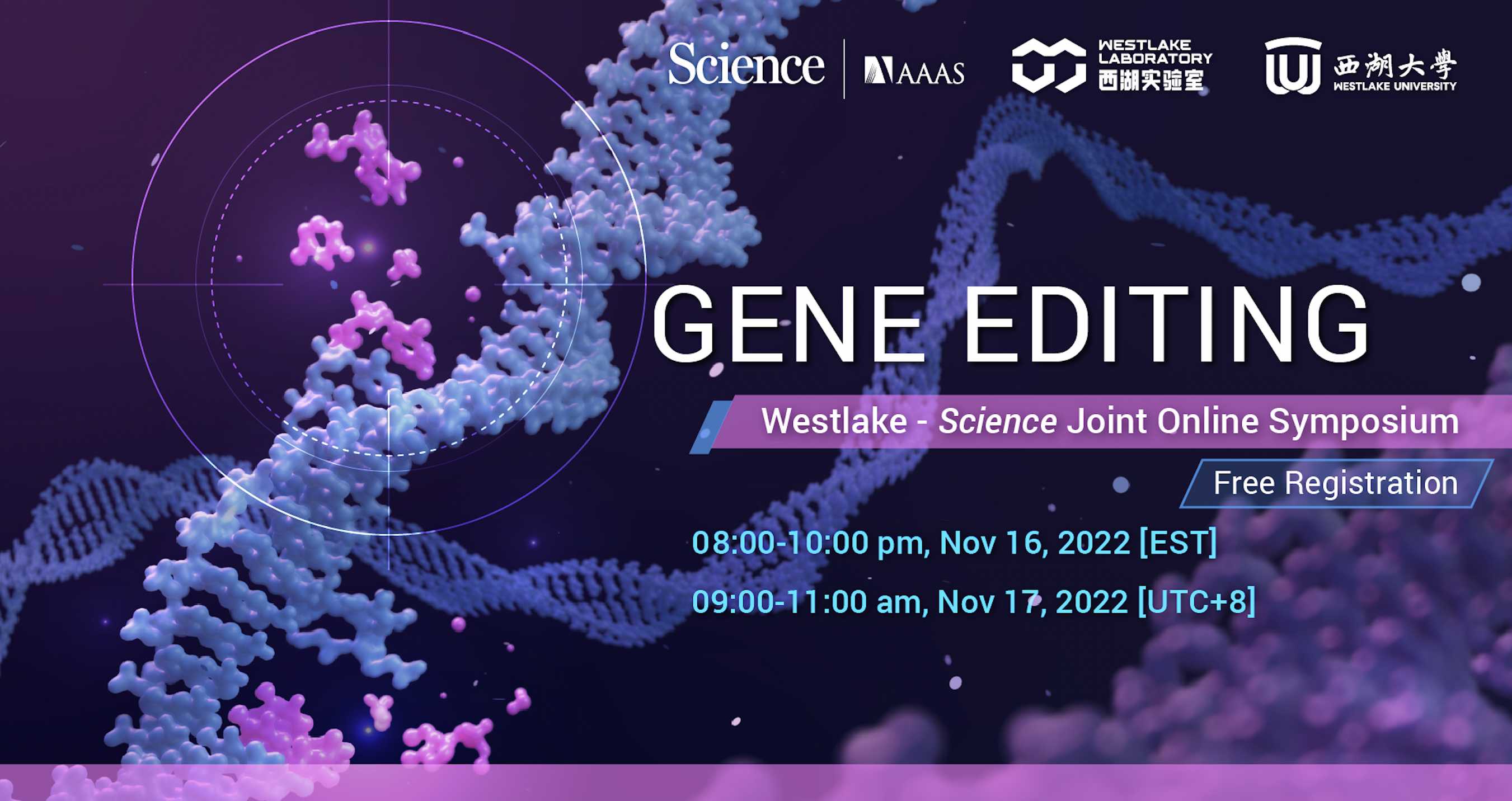
On November 17th 2022 the first online symposium of a 10-part series jointly organized by Science/AAAS and Westlake University, entitled ‘Gene Editing’, welcomed three of the world’s leading gene-editing investigators to share their discoveries, inventions and perspectives on what lies in store for the future of biology, medicine and agriculture.
Broadcast live online to a global audience, the symposium was enjoyed by more than 20,600 viewers from universities, hospitals, scientific research institutions and pharmaceutical companies, and provided an open platform for the sharing of research and ideas.
Dr. David R. Liu, Dr. Caixia Gao and Dr. Jonathan Weissman delivered in-depth presentations and engaged in a roundtable discussion of the key issues and future innovations of the field, co-chaired by Dr. Lijia Ma and Dr. Di Jiang.
To enjoy a full playback of the symposium ‘Gene Editing’ jointly organized by Science/AAAS and Westlake University, please visit:
https://live.vhall.com/v3/lives/watch/925591016
SPEAKERS
Dr. David R. Liu
Broad Institute of MIT and Harvard
“Base Editing and Prime Editing: Precise Gene Correction without Double-Strand DNA Breaks”
Dr. Caixia Gao
Institute of Genetics and Developmental Biology, Chinese Academy of Sciences
“Genome Engineering for Crop Improvement and Future Agriculture”
Dr. Jonathan Weissman
Whitehead Institute, MIT, Koch Institute, Howard Hughes Medical Institute
“Single Cell Approaches to Follow Tumor Evolution with a ‘Molecular Flight Recorder’ and to Globally Define Gene Function with Comprehensive Genotype-phenotype Maps”
CO-CHAIRS
Dr. Lijia Ma
Distinguished Research Fellow, School of Life Sciences, Westlake University
Dr. Di Jiang
Senior editor of Science/AAAS
RESEARCH HIGHLIGHTS
The discovery of CRISPR genome editing ten years ago ushered in a new era in which the new technology of editing specific base pairs of segments of the DNA in cells and whole organisms profoundly transformed the fields of molecular biology, genetics and genomics, human disease diagnosis and treatment, as well as agriculture. This has been made possible by the expansion of the CRISPR Toolbox and creative applications of the new tools in basic research and experimental therapeutics.
Dr. David Liu from the Broad Institute of MIT and Harvard University introduced and shared the development, application, and optimizations of base editors, as well as the newly developed delivery systems.
As a leader in the field of gene editing and developer of base editors, Dr. David Liu has made significant achievements in gene editing and is widely considered to be at the forefront of the field. In 2016, Dr. Liu and his team developed the cytosine base editor CBE (C-T, G-A), the adenine base editor ABE (A-G, T-C) in 2017, the primer editor (primer editor, PE) in 2019, and a mitochondrial base editor in 2022. These base editors are DSB-independent and do not require the additional donor template. They are widely used in the treatment of genetic diseases caused by base mutations.
Dr. Caixia Gao focuses her research on genome engineering for the improvement of crop resistance and yields, and the future of agriculture. Genome editing is a fast, robust, and precise method in breeding new crops. Transgene-free genome editing via plasmid DNA or RNP delivery is an efficient and low off-target method. Genome editing can be used to rapidly generate elite wheat germplasm with robust powdery mildew resistance and enhanced yields.
Dr. Jonathan Weissman shared his and his teams’ research on CRISPR-based single-cell technology to track tumor evolution and define the relationships between genotypes and phenotypes. By developing Perturb-seq for in vivo application, it should be possible to screen essential genes with animal models effectively, thus enabling us to understand how these genetic mutations lead to disorders. The combined application of new technologies allows researchers to manipulate and study specific gene functions at single-cell resolution, revealing the impact of genetic variation on gene regulation.
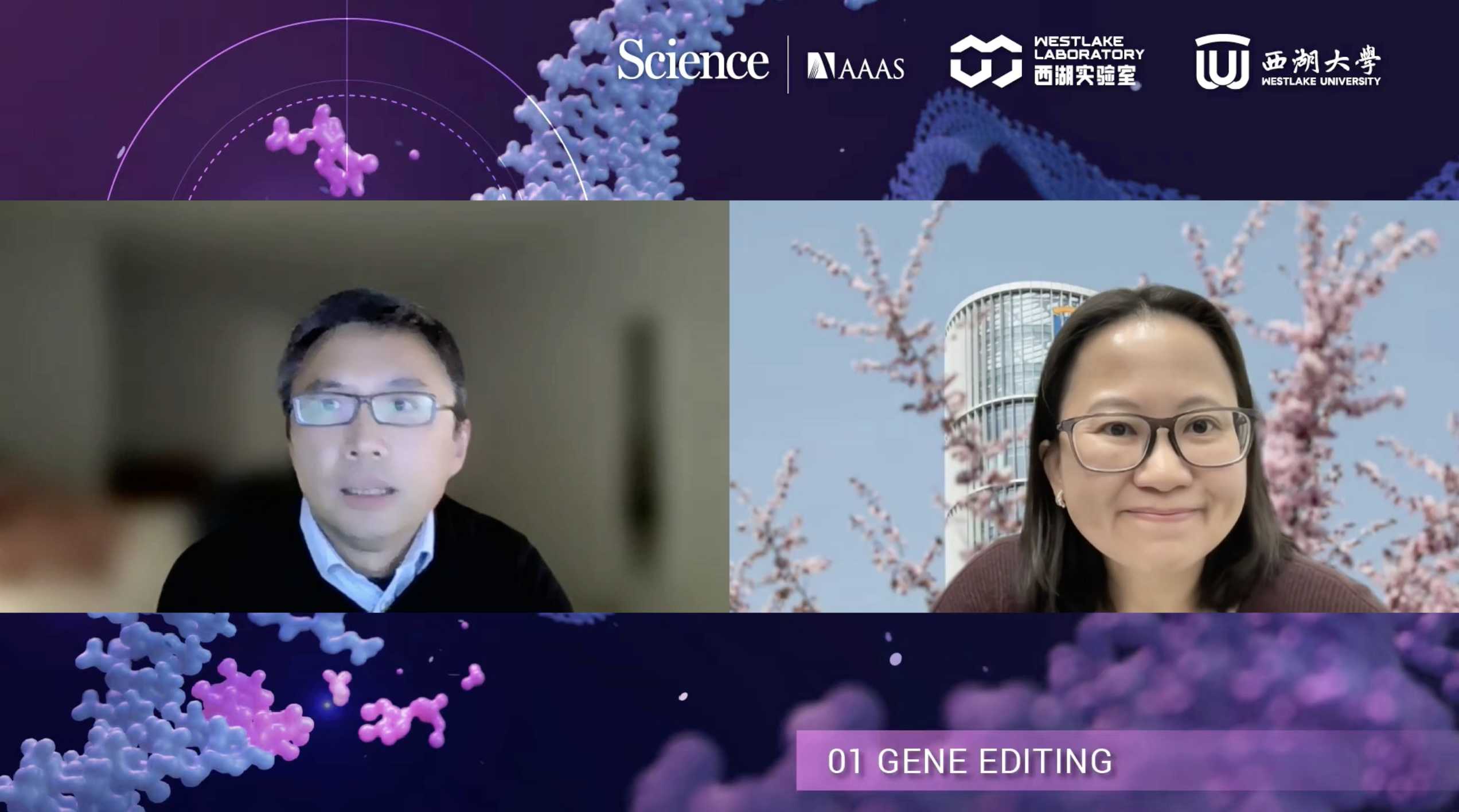
We are grateful to all of the speakers and chairs who participated in the first part of this symposium series and openly shared their insights and discoveries.
Looking ahead, part two of the series will focus on the theme of ‘Biomolecular Condensates’ and is scheduled to be held online on January 18th 2023 (7:00-9:00AM [EST]; 12:00-2:00PM [UTC]; 1:00-3:00PM [UTC+1]; 8:00-10:00PM [UTC+8]). Distinguished speakers will include Dr. Tony Hyman, Max Planck Institute of Molecular Cell Biology and Genetics, Dr. Amy Susanne Gladfelter, University of North Carolina at Chapel Hill, and Dr. Hong Zhang, Institute of Biophysics, Chinese Academy of Sciences, with the session co-chaired by Dr. Stella Hurtley, Science/AAAS and Dr. Peiguo Yang, Westlake University.
We hope you enjoyed part one.
RELATED
LAB SHOW
Westlake Holds First Westlake x Science Joint Online Symposium Gene Editing



-
STUDY WITH US
-
WORK WITH US
-
CONTACT US
-
YUNGU CAMPUS
-
No. 600 Dunyu Road, Sandun Town, Xihu District, Hangzhou, Zhejiang PR China Post code:310030 E-mail:office@westlake.edu.cn
-
-
YUNQI CAMPUS
-
No.18 Shilongshan Road Cloud Town, Xihu District, Hangzhou, Zhejiang PR China Post code:310024 E-mail:office@westlake.edu.cn
-
-
-
浙ICP备18025489号 浙公安备33010602007514号 Copyright © Westlake University. All Rights Reserved
-


If you are interested in supporting us or making a contribution, please contact:
Office of Public Affairs, Westlake University
Email: media@westlake.edu.cn
OR
Westlake Education Foundation
Email: office@wefoundation.org.cn
Phones: 0571-86886859
Fax: 0571-85271986
