


Search websites, locations, and people




ABOUT
ACADEMICS
RESEARCH
ADMISSIONS
NEWS & EVENTS
CAMPUS LIFE
INNOVATION
CAREERS

If you are interested in supporting us or making a contribution, please contact:
Public Affairs, Westlake Institute for Advanced Study
Email: info@wias.org.cn
OR
Westlake Education Foundation
Email: office@wefoundation.org.cn
Phones: 0571-86886859
Fax: 0571-85271986

High School Students Experience Cutting-edge Science in Countryside
31, 2023
Email: zhangchi@westlake.edu.cn
Phone: +86-(0)571-86886861
Office of Public Affairs
The first Westlake University Pre-college Summer Camp gathered 41 high school students from the US and China from July 9 to 24 for hands-on experiences in the university’s biology, chemistry, and engineering labs.
On one particularly eventful day, the class took place not in a lab, but rather the rice fields of Qingshan village, during a field trip. The mission? To explore the relationship between bats and crop growth
When the students arrived it was already dusk, but the heat and humidity were still intense. The dark, brooding clouds seemed to draw the sky closer to the ground, and dragonflies hovered over the rice plants, scattering as the students moved among them.
The students carefully assembled tripods and cameras and set them up in the field. Working with them were Marcel Balle, a research assistant in Prof. Thomas Wanger-Guerrero's lab in the School of Engineering, and Dong Sheng, one of this year’s new Ph.D. students. Balle and Dong walked the students through the experiments they were setting up and explained exactly what the cameras could be expected to capture in the darkness.
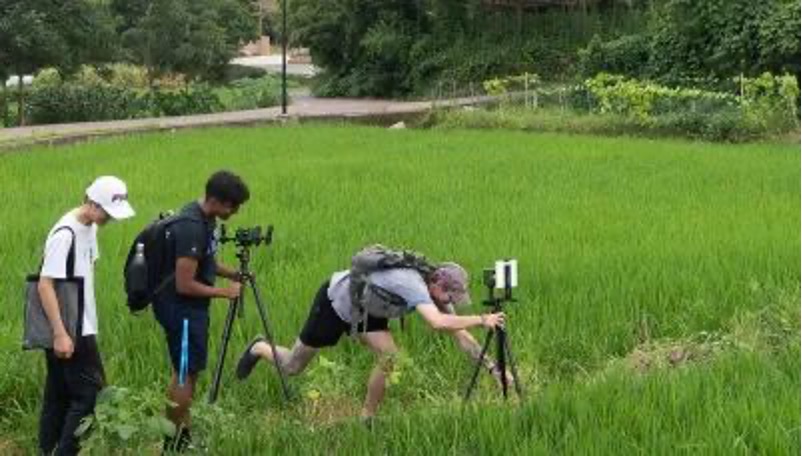
The cameras were part of a system, nicknamed “EcoEye”, that uses AI algorithms to monitor ecosystems. There are two cameras: one points at the sky and observes the numbers and activities of bats and bugs above the field, while the other points downwards to monitor the type, numbers, and activity of insects on the ground. The system is so sensitive that it can distinguish between different types of insects. This is a vast improvement on the conventional method of trapping and counting insects, as the AI-enhanced cameras continuously monitor the environment without disturbing the natural activity of the flora and fauna. AI also enhances the efficiency of capturing and processing data.
Preliminary data extracted during the experiment showed that the number of bats correlated closely with the number of active insects. Sheng explained the importance of this information. “Considering that many of these insects are treated as pests, we can use these insights to optimize the use of pesticides and in turn minimize the damage that agricultural chemicals cause to the ecosystem,” Sheng explained.
The Sustainable Agricultural Systems & Engineering Lab, led by Wanger-Guerrero, has set up similar monitoring systems in villages around Hangzhou and Hainan to study the relationship between biodiversity and sustainable agriculture.
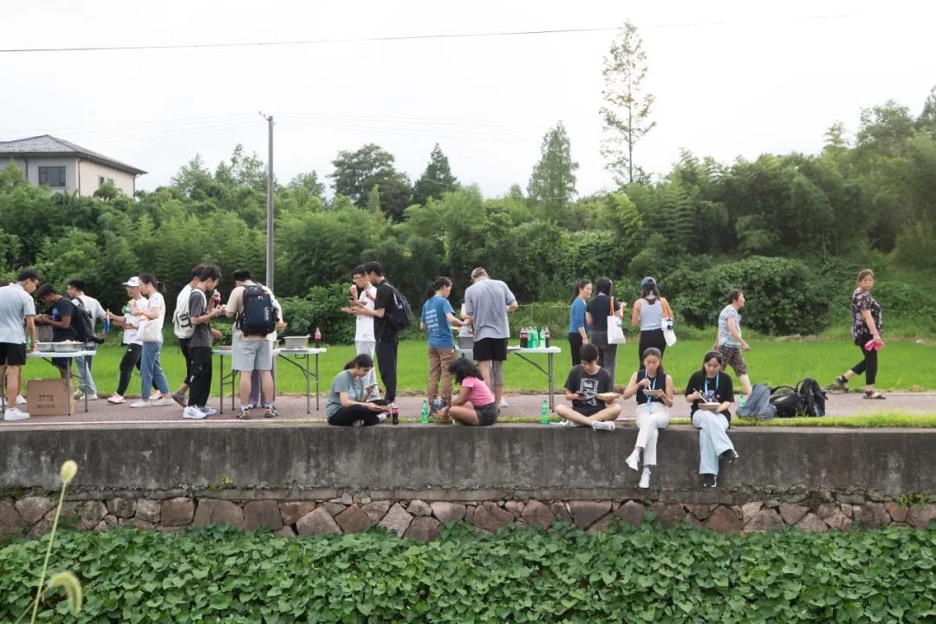
The students also studied another aspect of Qingshan’s ecosystem. To investigate the relationship between water quality in the Longwu reservoir and the bamboo forests around it, Yunya Wu took the students on a hike to the mountain top where the reservoir is situated. On their way up the mountain, the students passed through bamboo forests and skirted around ponds.
Wu is the project manager of Wanger-Guerrero’s field monitoring project, and she knows the village well. In the 80s, the villagers of Qingshan used the water from Longwu reservoir for both agricultural irrigation and daily domestic use. However, farmers started growing bamboo in the catchment area and the pesticides and fertilizers they used gradually polluted the land and seeped into the reservoir.
The pollution in the reservoir and the ecosystem of the village and its rice fields, although they seem far apart, are intimately linked. “Water is one of the basic elements of biodiversity,” Wu said, adding that biodiversity in the ecosystems of the villages is vitally important, since healthy ecosystems are essential for achieving sustainable agriculture.
Great efforts have been made to improve water quality, for example by completely banning motor vehicles from the reservoir. After years of work, the water quality of Longwu reservoir has returned to national A-level, and biodiversity in the local ecosystem is also recovering.
Aadi, a student from Illinois Mathematics and Science Academy, asked Sheng, Wu and Balle what motivates them to do research like this – in the fields, in the mountains, even in the rainforests of Brazil?
Sheng’s answer was,, “The imagination that comes with working in a crossover discipline.” As an undergraduate, he studied environmental science at Zhejiang University and took computer science and robotics courses on the side. On the opening day of the School of Engineering at Westlake, he met Wanger-Guerrero, his future supervisor and an expert on biodiversity. “Biodiversity perfectly combines what I learned in my undergraduate program and where my passion lies. I see it as an interesting challenge,” Sheng said.
To Wu and Balle, interest and passion are the main drivers. Aside from rice, Wanger-Guerrero’s lab also conducts long-term monitoring of the sustainable development of cocoa plantations around the world. “Do you like rice? Do you enjoy chocolate? That could be your motivation to join our lab and become a part of the effort to focus the power of research on sustainable agriculture,” Wu smiled.
Wanger-Guerrero hopes that the experience of this field trip will widen the horizons of the youngsters and focus their attention on the future of mankind. He understands that protecting biodiversity is crucial for the development, if not the survival, of human society, particularly because of its profound effect on food production and supply. Monitoring ecosystems plays a fundamental role in improving the utility of natural resources and securing the future of humanity. “We can only truly cherish nature when we have a profound understanding of it,” says Wanger-Guerrero. “This is why I find AI-enhanced ecosystem monitoring so exciting.”
RELATED



-
STUDY WITH US
-
WORK WITH US
-
CONTACT US
-
YUNGU CAMPUS
-
No. 600 Dunyu Road, Sandun Town, Xihu District, Hangzhou, Zhejiang PR China Post code:310030 E-mail:office@westlake.edu.cn
-
-
YUNQI CAMPUS
-
No.18 Shilongshan Road Cloud Town, Xihu District, Hangzhou, Zhejiang PR China Post code:310024 E-mail:office@westlake.edu.cn
-
-
-
浙ICP备18025489号 浙公安备33010602007514号 Copyright © Westlake University. All Rights Reserved
-


If you are interested in supporting us or making a contribution, please contact:
Office of Public Affairs, Westlake University
Email: media@westlake.edu.cn
OR
Westlake Education Foundation
Email: office@wefoundation.org.cn
Phones: 0571-86886859
Fax: 0571-85271986
