


Search websites, locations, and people




ABOUT
ACADEMICS
RESEARCH
ADMISSIONS
NEWS & EVENTS
CAMPUS LIFE
INNOVATION
CAREERS

If you are interested in supporting us or making a contribution, please contact:
Public Affairs, Westlake Institute for Advanced Study
Email: info@wias.org.cn
OR
Westlake Education Foundation
Email: office@wefoundation.org.cn
Phones: 0571-86886859
Fax: 0571-85271986

Optogenetics: Westlake x Science Joint Online Symposium #6
05, 2023
Email: zhangchi@westlake.edu.cn
Phone: +86-(0)571-86886861
Office of Public Affairs
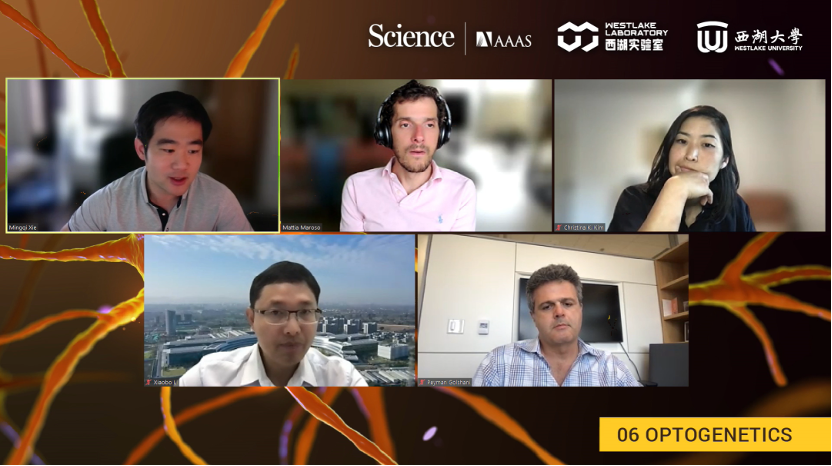
On May 25th 2023, over 25,400 viewers from around the world enjoyed the sixth part of our live, online symposium series jointly organized by Science/AAAS and Westlake University, entitled "Optogenetics."
World-renowned researchers Dr. Peyman Golshani (UCLA), Dr. Christina Kim (UC Davis) and Dr. Mingqi Xie (Westlake University) presented their published and ongoing work in different aspects of optogenetics, ranging from the development of new optogenetic methods for cell manipulation to coupling of optogenetic approaches with cell activity recording and gene expression profiling. The symposium, including the panel discussion, was co-chaired by Dr. Xiaobo Li (Westlake University) and by Dr. Mattia Maroso (Science/AAAS).
This online symposium promoted a platform for open dialogue and a discussion of topics and cutting-edge ideas in the field of optogenetics.
SPEAKERS
Dr. Peyman Golshani
Professor-in-Residence, Neurology, University of California Los Angeles
Topic: “New tools for recording neural dynamics in freely behaving animals”
Dr. Christina Kim
Assistant Professor, Center for Neuroscience and Department of Neurology, University of California, Davis
Topic: “Molecular tools for manipulating activated neural ensembles”
Dr. Mingqi Xie
Biosystems Engineering Laboratory, School of Life Sciences, Westlake University
Topic: “Optogenetic approaches for gene and cell-based therapies”
CO-CHAIRS
Dr. Xiaobo Li
Chloroplast Systems and Synthetic Biology Laboratory, School of Life Sciences, Westlake University
Dr. Mattia Maroso
Senior Editor of Science/American Association for the Advancement of Science
RESEARCH HIGHLIGHTS
Organisms use photoreceptors to sense light for vision or regulation of various behaviors. Photoreceptors can also be engineered into heterologous hosts to control their cellular activities and organismal behaviors, in a way orthogonal to pathways in the hosts. This young discipline is known as Optogenetics. Early examples of optogenetic efforts included precise excitement of selected neurons by targeted expression of heterologous photoreceptors that serve as both light-sensing rhodopsins and ion channels. Such tools have greatly enhanced our understanding of various aspects of our nervous system. Recently, optogenetic tools have been applied more broadly in areas ranging from therapeutic cells with light-responsive properties, to engineered plants with desired light-controlled behaviors in addition to their natural responses. And the types of photoreceptors employed have expanded to those that regulate protein phosphorylation, transcription, etc.
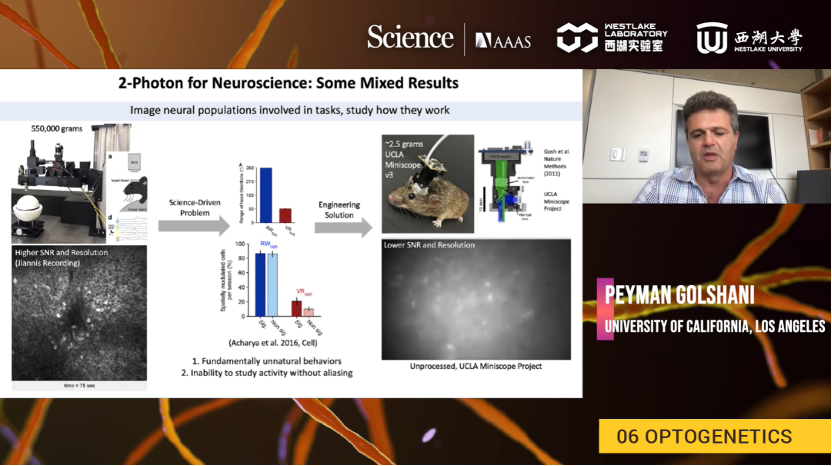
Dr. Peyman Golshani, a Professor-In-Residence and John Mazziotta Endowed Chair in the Department of Neurology at the University of California, Los Angeles, presented the first talk on the topic "New tools for recording neural dynamics in freely behaving animals." Imaging and neural activity recording of live, freely behaving animals has been an emerging research topic in neuroscience research in recent years. Dr. Golshani had over 10 years of experience in design and development of miniaturized microscopes that can be mounted onto the head of small animals such as mice. The Golshani lab aims to provide open-source miniscopes for neuroscience researchers worldwide, or share their miniscope craft techniques. In recent years, his lab applied the two-photon excitation technology in their miniscope for better tissue penetration. Some the miniscopes could be built with a cost lower than $1,000 USD. Even the two-photon ones with 700-micrometer penetration cost just around $8,000. The weight can be as low as 2.5 grams. The Golshani lab has helped around 500 other labs to build their own miniscopes.
In his talk, Dr. Golshani showed how the two-photon miniscope (Mini2P_v1.43) nicely tracked calcium signals visualized with the calcium fluorophore sensor (GCaMP7f). At the end of the presentation, Dr. Golshani summarized the remaining challenges in the employment of miniscopes for imaging freely behaving animals and emphasized the need for larger field of view (FOV). In the Q&A session, he mentioned that the utility of the microscope can be expanded to any signals that can be fluorescently labeled and compatible with two-photon excitation. Also, the microscope has two channels. In addition, he introduced how their imaging technologies can be combined with highly sensitive transcriptome sequencing to functionally dissect the nervous system at the single-cell level.
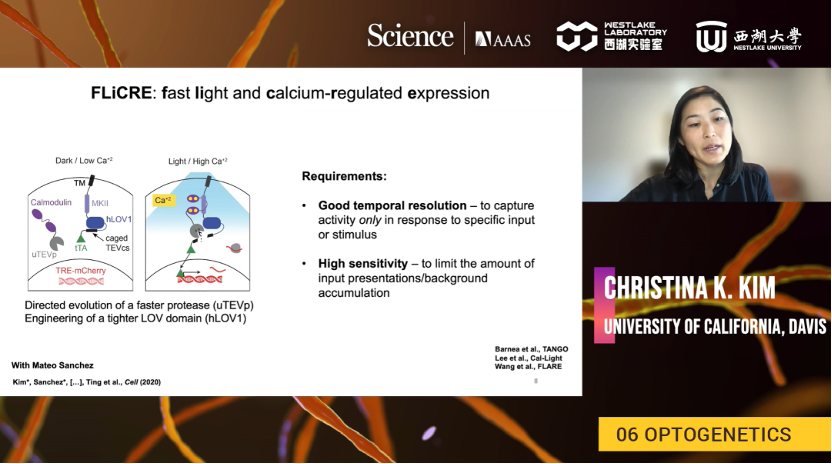
The second speaker, Dr. Christina Kim just started her lab in 2022 in the Department of Neurology at the University of California, Davis. During her Ph.D. and postdoctoral training, she worked with Prof. Karl Deisseroth and Prof. Alice Ting respectively. Dr. Kim started her talk with the big-picture of the treatment and interference of neurological and psychiatric disorders. She first pointed out that the main challenges still surround our limited understanding on how the nervous system works and that new tools are needed to rapidly overcome those challenges. She then focused on presenting one of the techniques that she developed: FLiCRE, which stands for Fast light and Calcium-Regulated Expression. Before FliCRE was developed, precise activation of selected neurons using the channelrhodopsin ChR2 had been commonly applied. However, such activations are transient and could not lead to neuron labeling on its own. FLiCRE was developed to resolve this problem. The FLiCRE system comprises of multiple constructs. It allows a transcription factor to enter the nucleus and turn on expression of a reporter gene only if two requirements are simultaneously met: illumination and calcium flux resulting from neuron activation. The data presented by Dr. Kim showed great temporal resolution and sensitivity to light triggers, and demonstrated the feasibility for neuron labeling using this tool. Next, Dr. Kim switched to a real-world problem: how to identify the functional connections between neurons in different brain regions? In theory, if a downstream neuron expression FLiCRE and if a trigger is applied to excite its upstream neuron, the downstream neuron would then receive a calcium signal and would turn on the expression of the reporter gene in the presence of light. Consequently, the downstream neuron would be successfully labeled. In a preliminary experiment by Dr. Kim and her collaborators, excitatory postsynaptic current analysis confirmed the neuronal connection suggested by the FLiCRE experiment. Through single-cell RNA sequencing, the identity of the downstream cells expressing the reporter gene was revealed. In the late part of her talk and Q&A session, Dr. Kim discussed the pros and cons of using laser as a light source versus employing chemiluminescence.
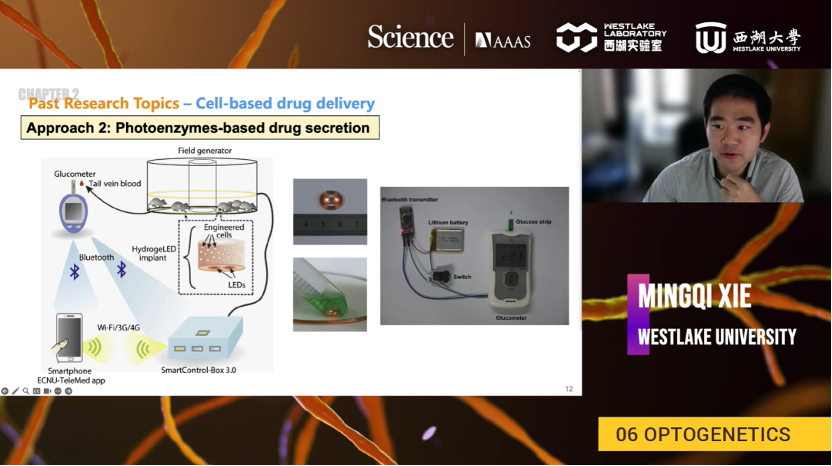
The final speaker, Dr. Mingqi Xie, from Westlake University focused on the synthetic biology design of cells for therapeutic uses. Dr. Xie introduced multiple examples of using light to control behaviors of such cells. The first example was about light-regulated release of protein drugs. Dr. Xie and his co-researchers optimized a system that uses melanopsin as a blue light sensor to manipulate the release of a secretable protein known as SEAP. They optimized the system to achieve reversable controls. Then, they applied this system on insulin secretion from engineered β cells, which will have applications in diabetes treatment. The second system was based on a light-dependent enzyme instead of a rhodopsin. The specific enzyme could perceive far-red light with better penetration than blue light. Dr. Xie and collaborators decided that it would be convenient for patients to control drug release using their smart phones. They engineered the system to be compatible with cell phone-emitted light as a light source or a cell phone app to wirelessly control a separate light source. Dr. Xie also presented unpublished work from his lab. They discovered a protein that binds specific RNA sequences but leaves RNA upon light excitation; previously light-regulated nucleic acid-binding proteins typically bind DNA or RNA under light but leave the molecules in dark. Additionally, because of the small size of this protein, its expression can be easily realized using the commonly-employed AAV-based vectors.
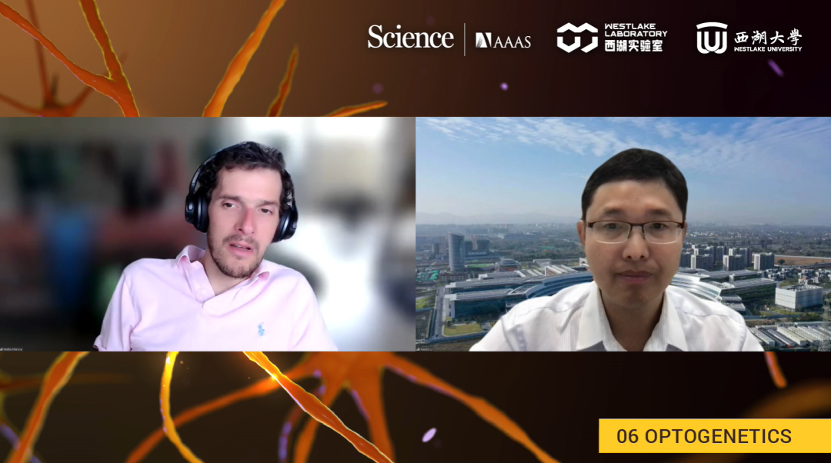
The 2-hour symposium concluded with an open Q&A discussion section whereby the speakers and co-chairs exchanged their views on the frontiers of the optogenetics discipline. They discussed the need for more molecular devices excitable by red light or far-red light, and how optogenetics could be better applied for clinical purposes beyond basic research.
To enjoy the full playback and open discussion of ‘Optogenetics’ jointly organized by Science/AAAS and Westlake University, please visit: https://live.vhall.com/v3/lives/watch/957350315
We would like to sincerely thank the three invited speakers, Dr. Peyman Golshani, Dr. Christina Kim, Dr. Mingqi Xie for their time and openness in sharing their latest research, as well as co-chairs Dr. Xiaobo Li and Dr. Mattia Maroso for their hosting and the panel discussion topics. We would also like to extend our gratitude to the audience who joined online and helped facilitate an international discussion.
Please check out our previous parts to this symposium series and we very much look forward to you joining us in our upcoming parts, as we work towards an open and global platform for scientific discussion and innovation.
Science/AAAS and Westlake University Symposium Series
Part 1 | Gene Editing | https://live.vhall.com/v3/lives/watch/925591016
Part 2 | Biomolecular Condensates | https://live.vhall.com/v3/lives/watch/340760384
Part 3 | Protein Engineering | https://live.vhall.com/v3/lives/watch/537973129
Part 4 | Dynamic Molecular Systems | https://live.vhall.com/v3/lives/watch/703086320
Part 5 | New Insights into Host–Virus Interactions | https://live.vhall.com/v3/lives/watch/123859990
Part 6 | Optogenetics | https://live.vhall.com/v3/lives/watch/957350315



-
STUDY WITH US
-
WORK WITH US
-
CONTACT US
-
YUNGU CAMPUS
-
No. 600 Dunyu Road, Sandun Town, Xihu District, Hangzhou, Zhejiang PR China Post code:310030 E-mail:office@westlake.edu.cn
-
-
YUNQI CAMPUS
-
No.18 Shilongshan Road Cloud Town, Xihu District, Hangzhou, Zhejiang PR China Post code:310024 E-mail:office@westlake.edu.cn
-
-
-
浙ICP备18025489号 浙公安备33010602007514号 Copyright © Westlake University. All Rights Reserved
-


If you are interested in supporting us or making a contribution, please contact:
Office of Public Affairs, Westlake University
Email: media@westlake.edu.cn
OR
Westlake Education Foundation
Email: office@wefoundation.org.cn
Phones: 0571-86886859
Fax: 0571-85271986
