


Search websites, locations, and people




ABOUT
ACADEMICS
RESEARCH
ADMISSIONS
NEWS & EVENTS
CAMPUS LIFE
INNOVATION
CAREERS

If you are interested in supporting us or making a contribution, please contact:
Public Affairs, Westlake Institute for Advanced Study
Email: info@wias.org.cn
OR
Westlake Education Foundation
Email: office@wefoundation.org.cn
Phones: 0571-86886859
Fax: 0571-85271986

World’s First Biomimetic Submersible to Dive to 2,000 Meters
19, 2023
Email: zhangchi@westlake.edu.cn
Phone: +86-(0)571-86886861
Office of Public Affairs
Humans have always been fascinated with the unknown. Many look up into the sky, counting the number of stars, while others look down below the blue waters of this planet. Throughout the millennia, a handful of brave individuals have sought out the unknown. They reach their hands into the sky and dive into the abyss of the sea.
Prof. Weicheng Cui was and still is a dream chaser. He once served as the chief designer and deputy chief architect of the "Jiaolong" project and went as deep as 7,035 meters in the Mariana Trench. At Westlake, he is leading a team to develop a third-generation biomimetic intelligent robotic fish. Assisting Cui is one of our youngest principal investigators, Prof. Dixia Fan, who graduated from MIT not long ago.
Although there is a 27-year age difference between Cui and Fan, they share the same dream and interest in exploring the deep sea.
Sea Guru–I is the first unmanned submersible biomimetic vessel to dive to over 2,000 meters in the South China Sea. The original prototype was unveiled at Westlake University’s Yungu Campus in November 2022. From April 18 to 27, 2023, Sea Guru-I embarked on a historic journey.
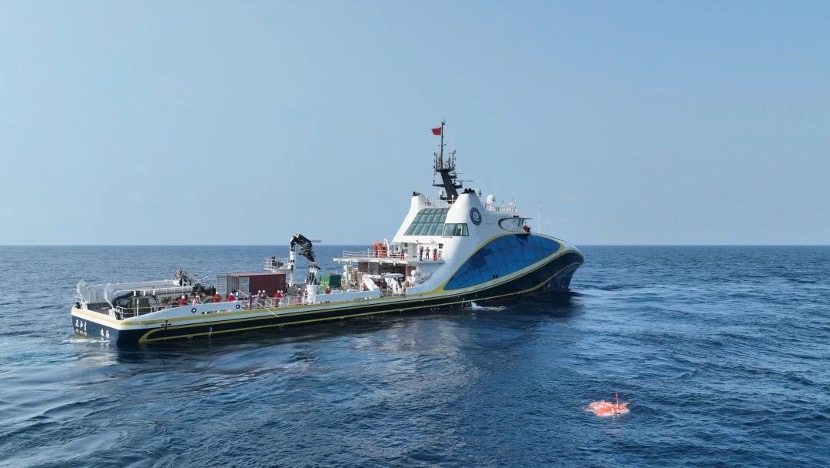
This South China Sea experiment marked the world’s first successful attempt at using a biomimetic structure-driven submersible at a depth of 2,000 meters. This also signified that the Sea Guru-I has become the deepest and most capable prototype of a new generation of biomimetic submarines.
Manta: Nature’s Greatest Teacher
Fish possess the fundamental ability to navigate the deep waters. However, merely resembling a fish was not enough. During the construction of Sea Guru-I, the teams aimed to accomplish two unprecedented tasks.
First, they wanted to create a biomimetic submersible that closely resembled real fish. The forward propulsion of the submersible would be achieved by oscillating its pectoral fins rather than relying on traditional propellers. The movement of the submersible would be entirely driven by the flapping motion of the fins.
Second, this biomimetic fish had to possess practical functionality. It was not intended solely for a leisurely swim in the deep sea but also had to be capable of performing operational tasks. This meant that the biomimetic fish had to be able to hover in the water or rest on the seabed while carrying out specified tasks.
The research and development team identified the manta as their biomimetic model early on. The manta, also known as the devil ray, has a flat body resembling a large blanket, thick pectoral fins similar to wings, and a slender, whip-like tail.
The flat body creates agility and ensures efficient swimming. A low center of gravity offers more stability and reduces the risk of capsizing. After all, the best way to explore nature is to become a part of nature itself. The potential doesn’t stop there. Like fish, instead of using propellers, the “fins” generate less noise and disturbance than previous generations. This makes Sea Guru-I perfect for ecological observation, sampling, monitoring, and other tasks that require high ecological and environmental protection requirements.
Making It Swim
Every new discovery comes with challenges. To make it “swim,” the team embarked on a journey to integrate the crucial fins into the vessel’s structure. Though Mother Nature does it with ease, mimicking the movements and functionality of fish fins to create enough propulsion was a completely different story.
The previous generation “Jiaolong” and “Fendouzhe” submersibles were equipped with traditional propeller systems. There was no off-the-shelf equipment for biomimetic equipment to learn from, not to mention finding suitable suppliers for the components. With limited options, the research team set off on a mission to design everything from scratch.
After countless sleepless nights, the team developed a set of cutting-edge artificial fins which were calibrated to replicate the fluid dynamics of their natural counterparts. The fins were seamlessly integrated into the submersible, allowing it free motion while maintaining stability in the water.
This biomimetic propulsion system offered not only efficient and agile movement but also significantly reduced noise and disturbance in the underwater environment. By imitating the graceful movements of a fish, the vessel became less obtrusive during its deep-sea exploration, minimizing its impact on the marine ecosystem.
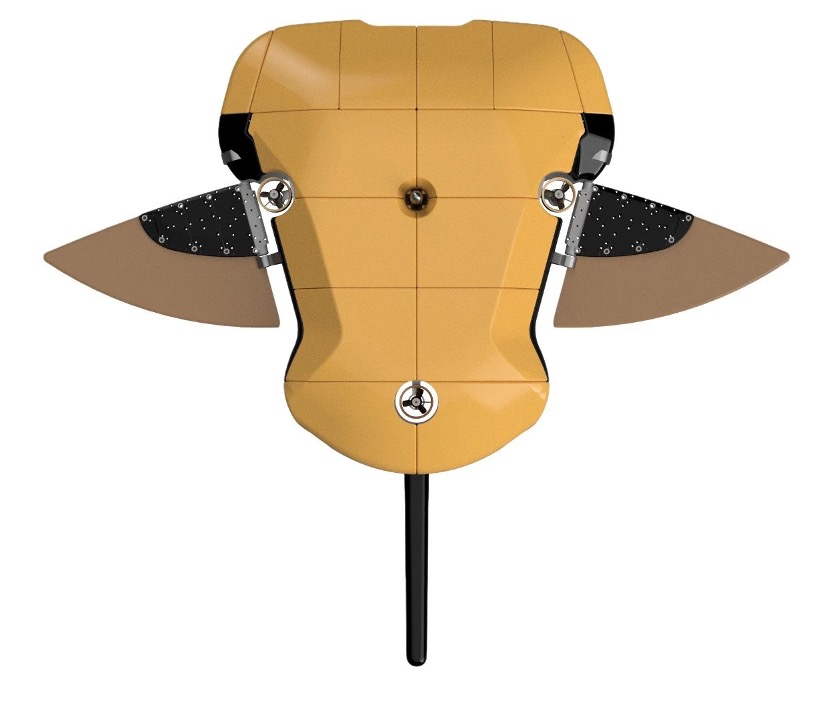 The image above shows the pair of “wings” on Sea Guru-I. The smaller black area represents the rigid plate, which provides sufficient pressure resistance to ensure normal movement in the deep waters. The larger yellow area is the flexible plate, which is the foundation for generating propulsion. During the oscillation process, the vortices formed in the water generate forward thrust, enabling the autonomous propulsion of the vessel.
The selection of materials was crucial. The team members chose high-density polyethylene (HDPE) for the flexible plate from numerous materials. HDPE is a flexible, rigid, corrosion-resistant plastic material that withstands various temperature differentials. As for the rigid plate, aluminum alloy has a slight advantage, providing the submersible with higher strength and lightweight characteristics while also resisting corrosion from seawater.
This raised a question — how thick and long should the fins be? What shape and proportions should the rigid and flexible materials be?
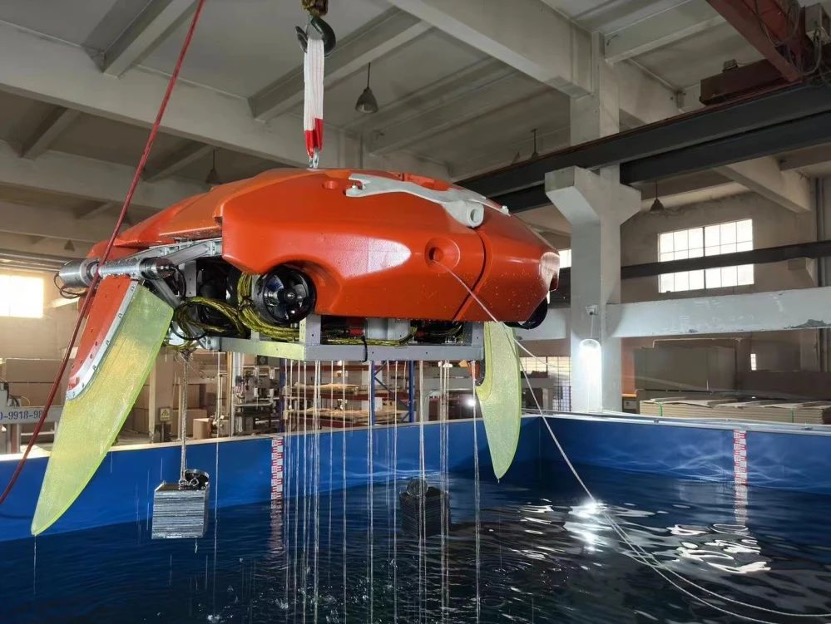
Any variations can potentially affect the thrust of the paired fins. The team members tested various combinations and possibilities. And finally, after two years of countless calculations and modifications, the first pure biomimetic fish submersible, “Sea Guru–I,” was born in their laboratory.
Making the Belly of the Beast
Creating the fins was only the first part of the project. But without a way to carry out underwater experiments and operations, everything was for naught. Therefore, the belly of the beast was created. The “belly” acts as a powerful docking station, integrating various experimental devices much like a “fish” consuming food. Sea Guru-I holds much untapped potential.
In the future, it can assist in underwater exploration and use imaging devices such as sonar. It can also be used to conduct surveys for coral reefs and ecological restoration. In terms of engineering, it can be used in underwater construction, inspections, and maintenance.
Sending It into the Abyss
On a clear and sunny day on April 18, 2023, the research team boarded the “Zhuhai Cloud” research vessel and began making history.
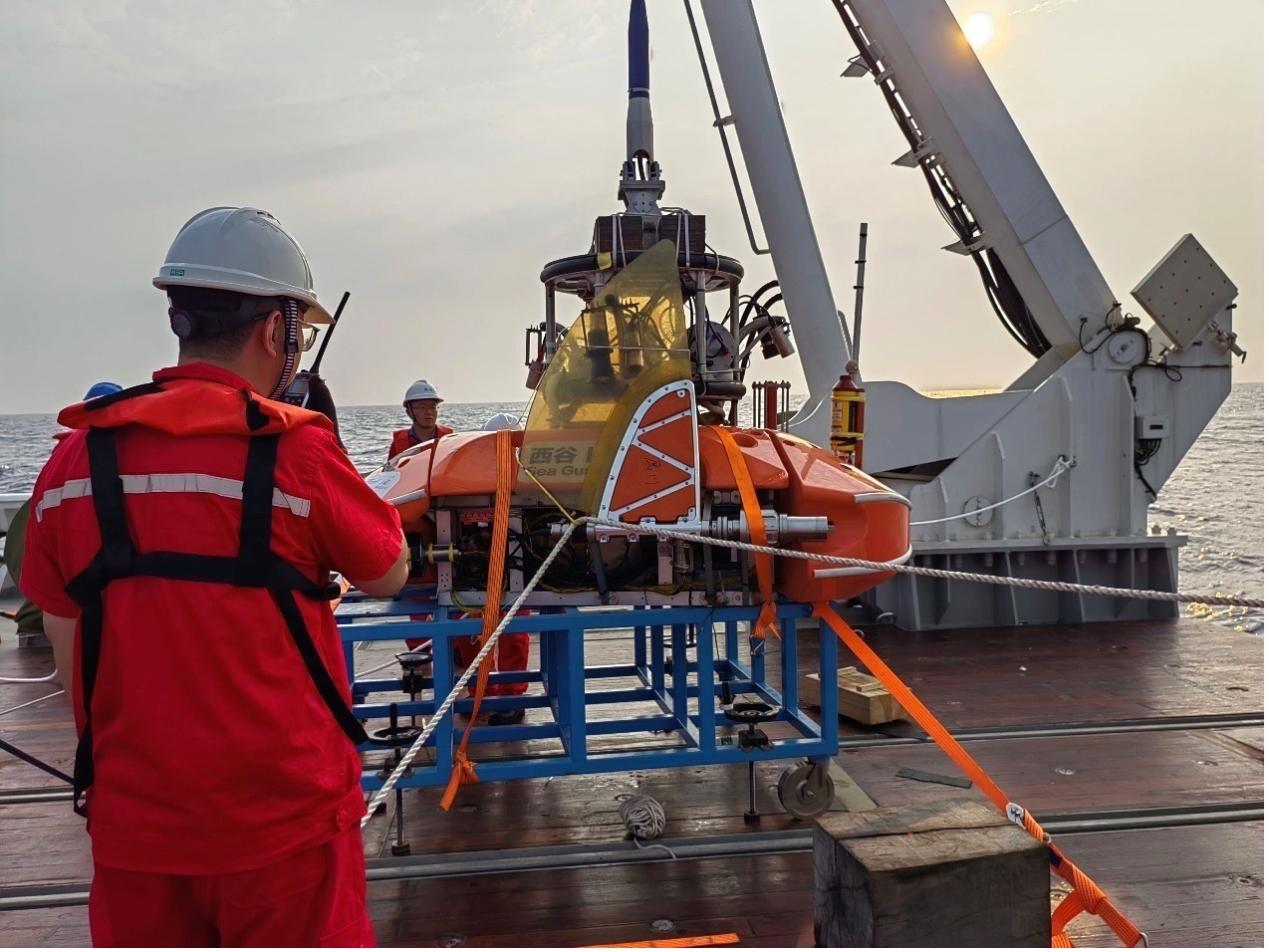
In the control room, everyone held their breath as they waited for the gradual descent of the vessel. But not everything went as planned. It wasn’t until their fifth attempt that Sea Guru-I finally reached the seafloor at a depth of 2,036 meters, where it successfully began collecting and transmitting data. On the next dive, it descended to a depth of 2,022 meters and separated from the Repeater. It conducted biomimetic-driven cruising on the seafloor with successful recovery.
The Sea Guru-I has significantly lower manufacturing and maintenance costs than other commonly used deep-sea submersibles. The two successful dives proved the operation capabilities beyond 2,000 meters. It also showed the capacity and potential of our research team to create great things. Also, it is worth mentioning that neither Cui nor Fan served as the chief designer of Sea Guru-I. They only participated as advisors to the project. The entire development team consisted of only Zoomers.
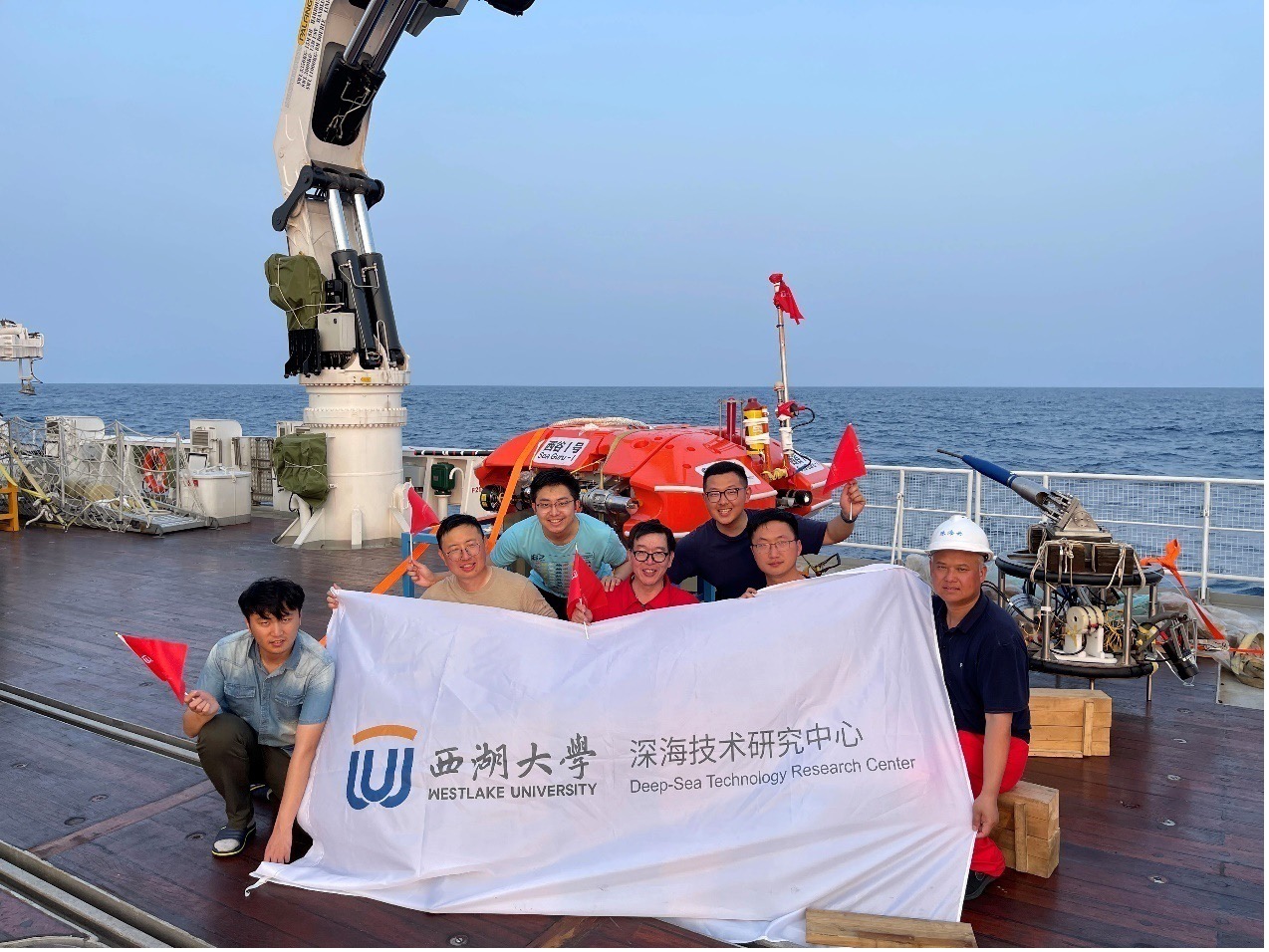
Talent is like buried treasure. It is our job to discover them and give them the opportunity to shine. Most of the brains behind the design had no prior experience at sea, and many things were learned and put to use on the spot.



-
STUDY WITH US
-
WORK WITH US
-
CONTACT US
-
YUNGU CAMPUS
-
No. 600 Dunyu Road, Sandun Town, Xihu District, Hangzhou, Zhejiang PR China Post code:310030 E-mail:office@westlake.edu.cn
-
-
YUNQI CAMPUS
-
No.18 Shilongshan Road Cloud Town, Xihu District, Hangzhou, Zhejiang PR China Post code:310024 E-mail:office@westlake.edu.cn
-
-
-
浙ICP备18025489号 浙公安备33010602007514号 Copyright © Westlake University. All Rights Reserved
-


If you are interested in supporting us or making a contribution, please contact:
Office of Public Affairs, Westlake University
Email: media@westlake.edu.cn
OR
Westlake Education Foundation
Email: office@wefoundation.org.cn
Phones: 0571-86886859
Fax: 0571-85271986
