


Search websites, locations, and people




ABOUT
ACADEMICS
RESEARCH
ADMISSIONS
NEWS & EVENTS
CAMPUS LIFE
INNOVATION
CAREERS

If you are interested in supporting us or making a contribution, please contact:
Public Affairs, Westlake Institute for Advanced Study
Email: info@wias.org.cn
OR
Westlake Education Foundation
Email: office@wefoundation.org.cn
Phones: 0571-86886859
Fax: 0571-85271986

Single-cell Genomics: Westlake x Science Joint Online Symposium #9 Written by Guanglei Xie, Yijing Jiang and Xi Wang
23, 2023
Email: zhangchi@westlake.edu.cn
Phone: +86-(0)571-86886861
Office of Public Affairs
On September 26, 2023, the ninth session of our online symposium series jointly organized by Science/AAAS, Westlake University and Westlake Laboratory was successfully held. This symposium was focused on advances in “Single-Cell Genomics”.
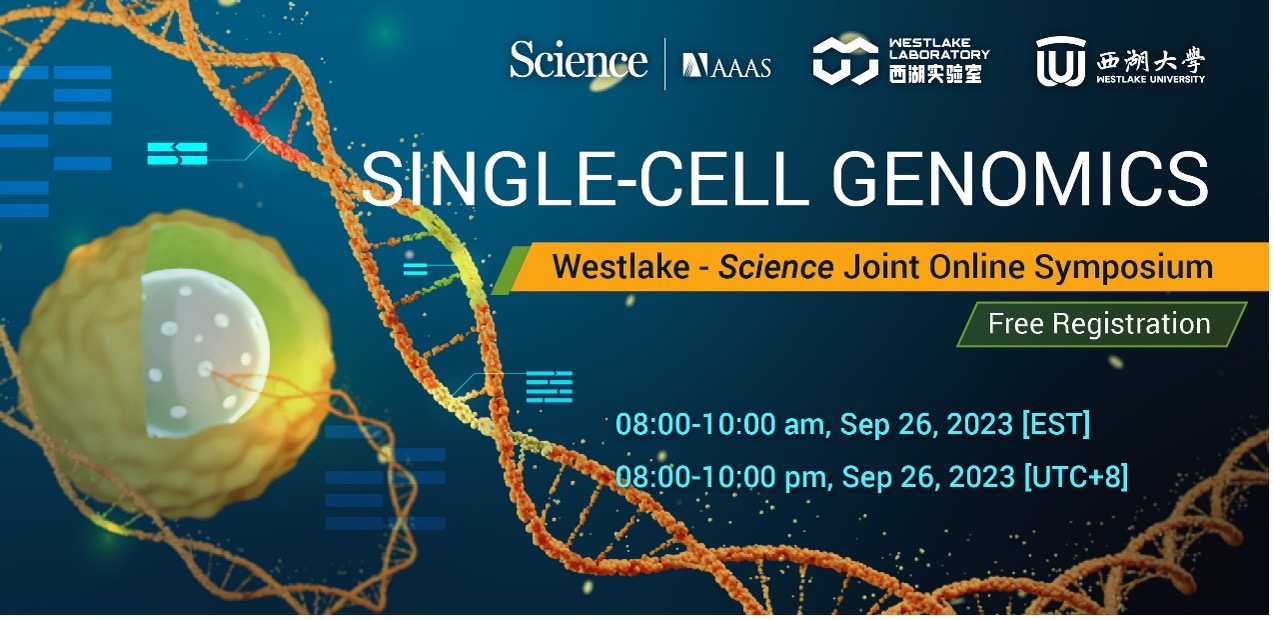
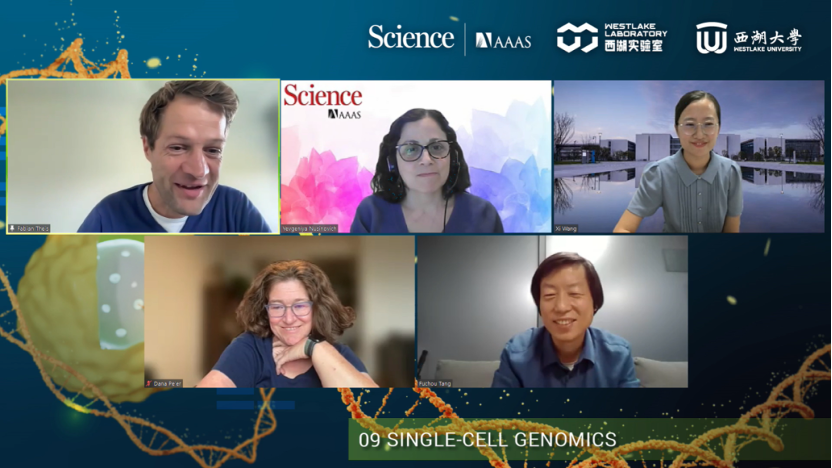
Until recently, genomic analysis could only be performed on entire tissue samples, containing a variety of cell types and states. Although this type of bulk tissue analysis yielded some useful information, it made it difficult to identify biologically meaningful patterns and discern what happens in individual cells, especially in those that are relatively rare. The arrival of single-cell analysis in recent years led to an explosion of insights into the biology of normal tissues and various diseases. In this symposium, three distinguished speakers, Dr. Dana Pe'er (Memorial Sloan Kettering Cancer Center), Dr. Fuchou Tang (Peking University), and Dr. Fabian Theis (Helmholtz Munich) discussed their exciting findings using single cell approaches, as well as the current state-of-the-art and future directions of this field. The symposium was co-hosted by Dr. Xi Wang (Westlake University) and Dr. Yevgeniya Nusinovich (Science/AAAS).
RESEARCH HIGHLIGHTS
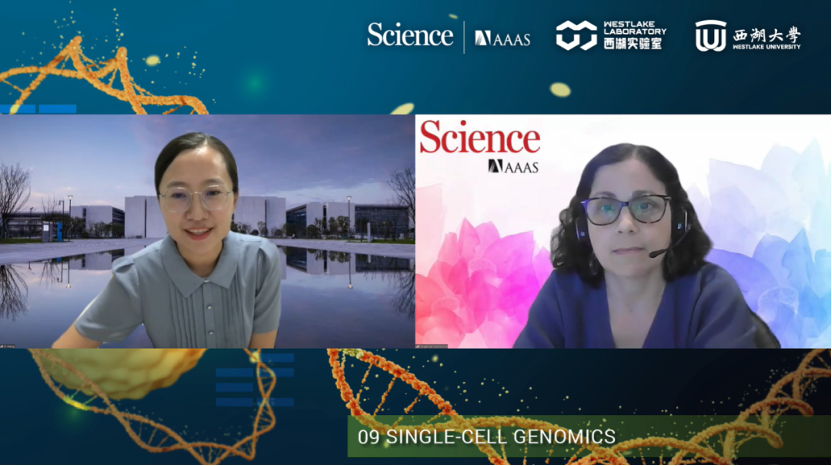
Dana Pe’er, an HHMI Investigator, Chair of the Computational and Systems Biology Program and Director of the Gerry Metastasis and Tumor Ecosystems Center at the Sloan Kettering Institute, opened the symposium with her talking focusing on ‘Beyond Cells: The Importance of Gene Programs.’
Dr. Dana Pe'er introduced two newly developed machine learning models, Spectra and DECIPHER, and their applications in the analysis of single-cell transcriptomic data. These models can be used to discover new functional gene programs. Dr. Dana Pe'er compared Spectra with previously published methods using the Cytopus database and found that Spectra exhibited higher robustness and interpretability. Spectra can separate tumor reactive genes from exhaustion genes in T cells. Using a breast cancer immunotherapy response dataset as example, a new gene program that is resistant to tumor immunotherapy was discovered in tumor-associated macrophages by Spectra. Finally, Dr. Dana Pe'er introduced the DECIPHER model, which can identify abnormal cell trajectories under pathological conditions. The DECIPHER model is based on the scVI model and adds an additional layer of nodes to this neural network framework. Similar to factor analysis in Spectra, DECIPHER can effectively infer the differentiation and initiation processes in single-cell transcriptomic data. In comparison with previously published models, DECIPHER demonstrated its performance in NPM1 mutant leukemia. Through the introduction of these two innovative models, Dr. Dana Pe'er has provided a new perspective for the development of methods for single-cell data analysis.
Fuchou Tang, professor at BIOPIC, College of Life Science, Peking University, was the second speaker and he discussed 'Single Cell Omics Sequencing Technologies: The Third Generation.'
Dr. Tang's laboratory has developed various single-cell genomics sequencing techniques and applied them to the research of embryonic development and tumor biology. In this talk, Dr. Tang focused on introducing two newly developed single-cell technologies based on third generation sequencing, scNanoHi-C and scNanoCOOL-seq. The scNanoHi-C technology utilizes Nanopore sequencing to study the three-dimensional genome interactions of single cells, enabling efficient detection of chromosomal interactions between neighboring chromosomes. Dr. Tang uses the interaction loops formed by MIR155HG and RUNX3 with super-enhancers to demonstrate that the performance of scNanoHi-C is comparable to the previously developed scHi-C technology. Furthermore, scNanoHi-C can consistently detect chromosomal regions, A/B compartment structures, the formation of topologically associating domains (TADs) and even the X chromosome inactivation. In addition, by comparing the similarity of copy number patterns between bulk Hi-C technology and traditional whole-genome sequencing (WGS, ~60X), scNanoHi-C can be used to accurately detect copy number profiles of individual cancer cells. Dr. Tang shows through scNanoHi-C technology that multiple enhancers interact with the promoters of transcription factors (such as EBF1, MIR155HG), ensuring a high level of gene expression. scNanoHi-C can also be used for genome assembly. Dr. Tang then introduces the single-cell multi-omics scNanoCOOL-seq technology, which can simultaneously detect DNA methylation status, chromatin accessibility, and transcriptome in the same cell. With the advantage of long-read sequencing, scNanoCOOL-seq can detect the epigenetic modification features of the entire CpG islands and gene promoter regions. Finally, Dr. Tang believes that the continuous development of these technologies can improve our understanding of the epigenetic regulatory relationships at the single-cell level.
Fabian Theis, Director of Helmholtz Munich Computational Health Center and Scientific Director of HelmholtzAI, was the last speaker. He introduced how to use “Generative AI for Modeling Single-cell Responses”.
Dr. Theis utilizes artificial intelligence to reveal the secrets of human cells, employing single-cell sequencing to analyze and model heterogeneities at the cellular level. He also constructs large-scale cell atlases using scRNA-seq and spatial omics data. Based on these atlases, intelligent mining of data patterns can be achieved using neural networks. Dr. Theis illustrated the example of an integrated lung organ cell atlas (LungCellAtlas) and demonstrated how machine learning methods, such as transfer learning strategies, can be employed to extend the atlas when new data is collected. This facilitates the detailed annotation of different cell states and the exploration of relationships between various cell types, states and factors such as age, gender, and smoking status. By combining interpretable linear models with flexible deep learning frameworks, it is possible to investigate the impact of drug responses at cellular level. Dr. Theis also discussed the important steps in single-cell data analyses, including data collection, data normalization, model training, model evaluation, and multi-step model optimization. He also introduced several single-cell sequencing analysis tools, such as scverse, sc-best-practices.org, and scTab. Dr. Theis’s talk ends by proposing to use generative AI “foundation model” to model single cell states and responses.
The symposium concluded with an open Q&A discussion section whereby insightful and innovative ideas were shared between the speakers and co-chairs. To enjoy the full playback and open discussion of ‘Single-cell Genomics’ jointly organized by Science/AAAS and Westlake University, please visit: https://live.vhall.com/v3/lives/watch/716914718
We would like to thank Dr. Pe’er, Dr. Tang, and Dr. Theis for their insightful talks, and thank our audience for participating in this exciting event. We really appreciate their time for sharing their latest findings and enthusiasm for scientific research and innovation. We would also like to thank our co-hosts Dr. Xi Wang and Dr. Yevgeniya Nusinovich, and all the staff at Science/AAAS, Westlake Laboratory, and Westlake University for their support.
Please check out our previous parts of this symposium series, and we very much look forward to you joining us in our final upcoming part 10, as we work towards an open and global platform for scientific discussion and innovation.
Science/AAAS and Westlake University Symposium Series
Part 1 | Gene Editing | https://live.vhall.com/v3/lives/watch/925591016
Part 2 | Biomolecular Condensates | https://live.vhall.com/v3/lives/watch/340760384
Part 3 | Protein Engineering | https://live.vhall.com/v3/lives/watch/537973129
Part 4 | Dynamic Molecular Systems | https://live.vhall.com/v3/lives/watch/703086320
Part 5 | New Insights into Host–Virus Interactions | https://live.vhall.com/v3/lives/watch/123859990
Part 6 | Optogenetics | https://live.vhall.com/v3/lives/watch/957350315
Part 7 | Imaging Tissues, Cells and Molecules | https://live.vhall.com/v3/lives/watch/418528741
Part 8 | Mechanobiology | https://live.vhall.com/v3/lives/watch/166361837
Part 9 | Single-cell Genomics | https://live.vhall.com/v3/lives/watch/716914718
RELATED
ACADEMICS
Single-cell Genomics: Westlake x Science Joint Online Symposium #9 Written by Guanglei Xie, Yijing Jiang and Xi Wang



-
STUDY WITH US
-
WORK WITH US
-
CONTACT US
-
YUNGU CAMPUS
-
No. 600 Dunyu Road, Sandun Town, Xihu District, Hangzhou, Zhejiang PR China Post code:310030 E-mail:office@westlake.edu.cn
-
-
YUNQI CAMPUS
-
No.18 Shilongshan Road Cloud Town, Xihu District, Hangzhou, Zhejiang PR China Post code:310024 E-mail:office@westlake.edu.cn
-
-
-
浙ICP备18025489号 浙公安备33010602007514号 Copyright © Westlake University. All Rights Reserved
-


If you are interested in supporting us or making a contribution, please contact:
Office of Public Affairs, Westlake University
Email: media@westlake.edu.cn
OR
Westlake Education Foundation
Email: office@wefoundation.org.cn
Phones: 0571-86886859
Fax: 0571-85271986
