


Search websites, locations, and people




ABOUT
ACADEMICS
RESEARCH
ADMISSIONS
NEWS & EVENTS
CAMPUS LIFE
INNOVATION
CAREERS

If you are interested in supporting us or making a contribution, please contact:
Public Affairs, Westlake Institute for Advanced Study
Email: info@wias.org.cn
OR
Westlake Education Foundation
Email: office@wefoundation.org.cn
Phones: 0571-86886859
Fax: 0571-85271986

Cancer Immunology: Westlake x Science Joint Online Symposium #10
15, 2023
Email: zhangchi@westlake.edu.cn
Phone: +86-(0)571-86886861
Office of Public Affairs
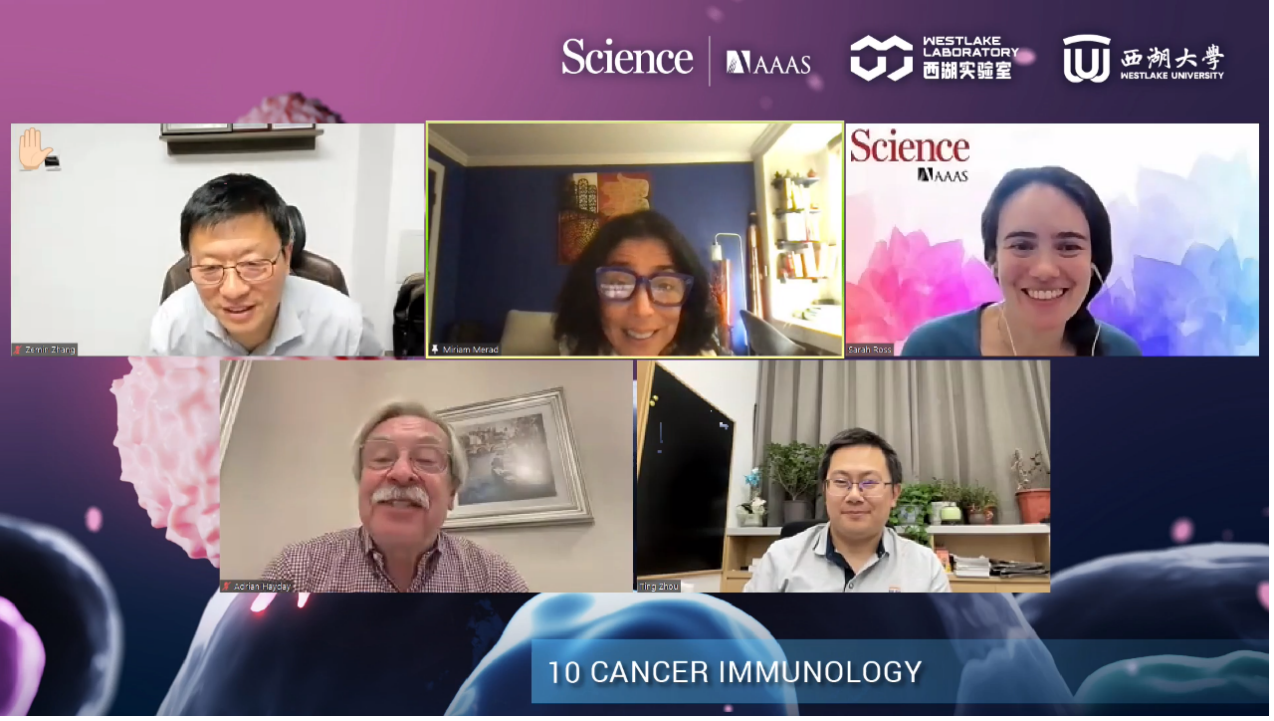
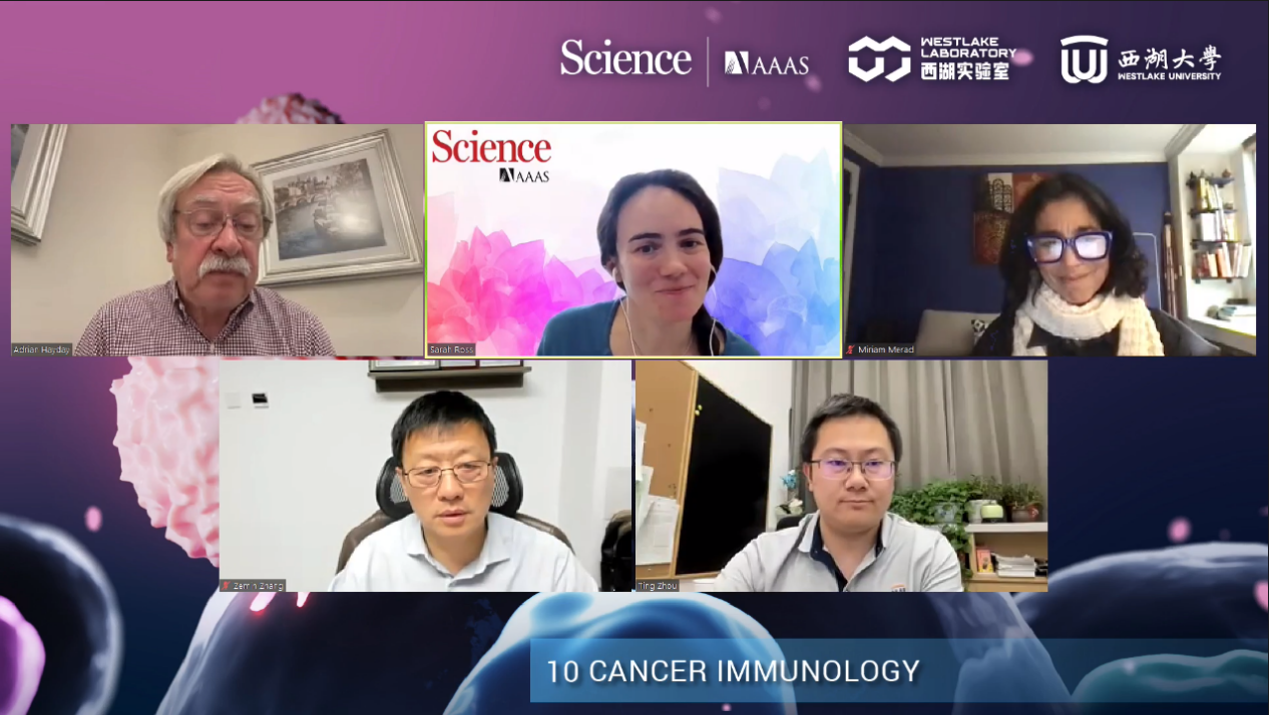
On October 24, 2023, the tenth webinar jointly hosted by Westlake University / Westlake Laboratory and Science/AAAS focused on "Cancer Immunology." The webinar invited three renowned scholars in the field of cancer immunology: Dr. Adrian Hayday from King's College London, Dr. Zemin Zhang from Peking University, and Dr. Miriam Merad from Mount Sinai Icahn School of Medicine. They shared their insights on the role of the immune system in the development, progression, and treatment of cancer. The meeting was co-chaired by Dr. Sarah Ross, editor of Science Magazine, and Dr. Ting Zhou, assistant professor at Westlake University.
RESEARCH HIGHLIGHTS
The first speaker, Dr. Adrian Hayday, focused on "Pan-cancer immunotherapy by detecting cell pathology rather than neo-antigens". His research centers on γδ T cells, a unique subgroup of T cells scarce in secondary lymphoid organs but abundant in many peripheral tissues like the skin and gut. Dr. Hayday emphasized the differences in antigen recognition between γδ T cells and traditional αβ T cells, as well as their ability to recognize various types of cancer cells, especially when cancer cells express low MHCI/HLA1, making therapies like anti-PD-1/PDL-L1 still effective. He also showed certain types of γδ T cells with anti-tumor capabilities, providing a basis for immunotherapy strategies targeting γδ T cells. Additionally, he discussed the ability of γδ T cells to monitor the transition of cells from a physiological to a pathological state, especially their interaction with epithelial cells in maintaining the stability of the skin barrier.
Next, Professor Zemin Zhang presented his talk on "Towards the holistic understanding of the tumor microenvironment through single cell data integration". Tumors are not just a collection of cancer cells but also include endothelial cells, fibroblasts, and various immune cells, forming a complex system. His team's extensive analysis of single-cell RNA-seq data from the tumor microenvironment has led to an understanding of tumor heterogeneity. They conducted a pan-cancer analysis of bone marrow single-cell data from 210 patients across 21 cancer types, identifying distinctive characteristics of tumor-infiltrating myeloid cells in different cancers and establishing a high-resolution pan-cancer T cell atlas. In a recent article published in Cell, his team performed single-cell RNA sequencing analysis on NK cells from 716 cancer patients, covering 24 types of cancer, revealing tumor-type-specific heterogeneity in NK cell composition. They identified a subgroup of CD56dimCD16hi NK cells, or TaNK cells, enriched in tumors, showing impaired anti-tumor functions and associated with poor prognosis and resistance to immunotherapy. Their research also uncovered interactions between TaNK cells and pro-inflammatory macrophages and LAMP3-DC in the tumor microenvironment, providing crucial insights into understanding the tumor microenvironment. In recent years, they have collected immune cell data from approximately 809 patients across 24 types of cancer, analyzing the distribution of different cell types in various tissues, offering a complete view of the heterogeneity of the tumor immune microenvironment and laying the groundwork for developing targeted immunotherapy strategies for tumor heterogeneity.
The third speaker, Dr. Miriam Merad discussed "Targeting Myeloid Cells in Cancer." She emphasized the need in cancer immunotherapy to eliminate immune suppressive effects to enhance the ability of immune cells to inhibit tumor growth and clear tumor cells, while also avoiding overactivation of immune cells to prevent tissue damage. Dr. Merad's research focuses on enhancing the tumor-fighting capability of the immune system without causing tissue damage. Her team analyzed clinical data of hepatocellular carcinoma patients from the TARGET platform, finding that although 75% of patients had significant T cell infiltration in their tumors, their response to targeted PD-1 therapy was limited. Single-cell transcriptomic data showed that in responsive patients, there was a notable expansion of CD8+ T cells and CXCL13+ CD4+ T cells in tumor areas compared to non-tumor areas, while such cells were scarce in non-responsive patients. Further analysis revealed a significant expansion of Treg cells in non-responsive patients. Integrating single-cell transcriptomics and single-cell TCR data, the Merad team found differences in the fate of tumor-infiltrating CD8+ T cells between responsive and non-responsive patients, with more CD8+ T cells in a progenitor state in non-responsive patients. Using PIC-seq technology, her team discovered that CXCL13+ CD4+ Th cells could physically bind to mregDC, and combining single-cell transcriptomics with iterative multiplex immunohistochemistry, they found these two cell types formed a triad with CD8+ progenitor cells, thereby promoting the production of effector CD8+ T cells. Her team is further investigating how to prevent mregDC from falling into a regulatory phenotype to enhance anti-tumor immune responses.
Overall, the three researchers showcased important and cutting-edge studies in cancer immunology and also actively discussed the future treatment strategies.
The symposium concluded with an open Q&A discussion section whereby insightful and innovative ideas were shared between the speakers and co-chairs. To enjoy the full playback and open discussion of ‘Cancer Immunology’ jointly organized by Science/AAAS and Westlake University, please visit:
https://live.vhall.com/v3/lives/watch/736409102
We would like to thank Dr. Adrian Hayday, Dr. Zemin Zhang, and Dr. Miriam Merad for their insightful talks, and thank our audience for participating in this exciting event. We really appreciate their time for sharing their latest findings and enthusiasm for scientific research and innovation. We would also like to thank our co-hosts Dr. Sarah Ross and Dr. Ting Zhou, and all the staff at Science/AAAS, Westlake Laboratory, and Westlake University for their support.
Please check out our previous parts of this symposium series, and we very much look forward to you joining us again in 2024 for the continuation of this symposium series, as we work towards an open and global platform for scientific discussion and innovation.
Science/AAAS and Westlake University Symposium Series
Part 1 | Gene Editing | https://live.vhall.com/v3/lives/watch/925591016
Part 2 | Biomolecular Condensates | https://live.vhall.com/v3/lives/watch/340760384
Part 3 | Protein Engineering | https://live.vhall.com/v3/lives/watch/537973129
Part 4 | Dynamic Molecular Systems | https://live.vhall.com/v3/lives/watch/703086320
Part 5 | New Insights into Host–Virus Interactions | https://live.vhall.com/v3/lives/watch/123859990
Part 6 | Optogenetics | https://live.vhall.com/v3/lives/watch/957350315
Part 7 | Imaging Tissues, Cells and Molecules | https://live.vhall.com/v3/lives/watch/418528741
Part 8 | Mechanobiology | https://live.vhall.com/v3/lives/watch/166361837
Part 9 | Single-cell Genomics | https://live.vhall.com/v3/lives/watch/716914718
Part 10 | Cancer Immunology | https://live.vhall.com/v3/lives/watch/736409102
RELATED



-
STUDY WITH US
-
WORK WITH US
-
CONTACT US
-
YUNGU CAMPUS
-
No. 600 Dunyu Road, Sandun Town, Xihu District, Hangzhou, Zhejiang PR China Post code:310030 E-mail:office@westlake.edu.cn
-
-
YUNQI CAMPUS
-
No.18 Shilongshan Road Cloud Town, Xihu District, Hangzhou, Zhejiang PR China Post code:310024 E-mail:office@westlake.edu.cn
-
-
-
浙ICP备18025489号 浙公安备33010602007514号 Copyright © Westlake University. All Rights Reserved
-


If you are interested in supporting us or making a contribution, please contact:
Office of Public Affairs, Westlake University
Email: media@westlake.edu.cn
OR
Westlake Education Foundation
Email: office@wefoundation.org.cn
Phones: 0571-86886859
Fax: 0571-85271986
